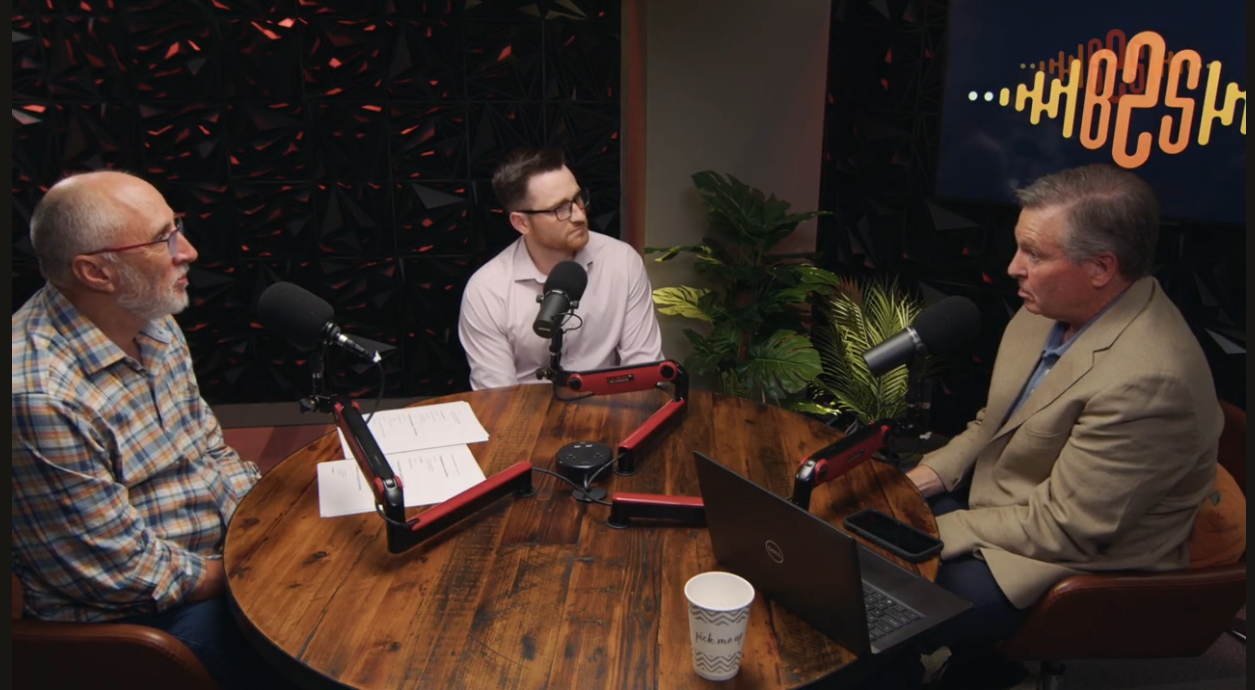


Listen to the specific part
Episode Transcript:
SCOTT MARTIN
I think we're really on the cusp of dynamic changes in our industry, and it's being driven because we're going to this electronic control platform.
GREG SIMPSON
Hey gang, Greg here. Welcome to the Built to Suit podcast, the pod built to build what is next. Today we have with us a pretty cool and exciting guy from Hill Phoenix, and we also have Kyle, our resident refrigeration expert. Welcome in, Scott.
SCOTT MARTIN
Thank you. Thanks for having me. Great to be here.
GREG SIMPSON
Normally when I dig into someone’s background, they started way over there and ended up way over here. With you, that’s not really the case.
SCOTT MARTIN
Not at all. I was born, and I was in this business nine months before I arrived.
GREG SIMPSON
So what did that look like?
SCOTT MARTIN
My grandfather started this journey for the Martin family, then my dad behind him. If I wanted to hang out with my dad and do father-son things, we went to work together working on refrigeration equipment and installing it. It didn’t feel like work. It was just me, a little boy, hanging out with his dad doing fun mechanical guy things.
GREG SIMPSON
Ace Refrigeration. Dad’s business, granddad’s business?
SCOTT MARTIN
Both. My grandfather started Ace Refrigeration in Albany, Georgia, sometime in the 1930s or early 1940s. Then my dad came along and took over the family business.
GREG SIMPSON
The family business could have been your family business. Why not?
SCOTT MARTIN
It could have been. If you asked my grandmother, it should have been. I thought she was going to disown me.
I went to four years of engineering school and told my dad, “I could have worked for you and never gotten my engineering degree, so I’d like to give engineering a go and see where I can take this.” He said, “Oh yeah, you should.”
GREG SIMPSON
So where did you go?
SCOTT MARTIN
My first job out of school was with Engineered Refrigeration Systems, one of the predecessor companies to Hill Phoenix. I had seen that equipment working in a Piggly Wiggly store in Albany, Georgia. I remembered the name and address, sent them a resume, and they hired me.
GREG SIMPSON
Atlanta is probably not the worst place to be in refrigeration.
SCOTT MARTIN
People don’t know this, but Atlanta is like the capital of refrigeration for the United States.
GREG SIMPSON
Talk about your current job.
SCOTT MARTIN
My official title is senior director of industry relations and compliance and engineering fellow for Hill Phoenix. I’m responsible for regulatory compliance activities, making sure we’re building compliant products for UL, NSF, DOE, EPA, and all the government agencies that regulate our equipment.
A big part of my job is representing Hill Phoenix in industry associations like AHRI and FMI and serving on committees for those associations.
KYLE KLAHRE
So that’s pretty easy stuff.
SCOTT MARTIN
It’s time consuming, let me tell you.
GREG SIMPSON
Kyle, you chase one line of regulation and Scott chases another. Do those regulations even cross?
SCOTT MARTIN
Yes, and not always in a good way. ASHRAE Standard 15 is the safety code for mechanical refrigeration. It governs a lot of the work you do and spills over from agency listings like UL into field connections.
KYLE KLAHRE
You’re focusing on manufacturers and equipment, while we’re looking at the full system and making sure it’s safe for the public.
SCOTT MARTIN
Exactly.
GREG SIMPSON
You seem part designer, part engineer, part salesman. What gets you up in the morning?
SCOTT MARTIN
Being able to communicate with everyone, from a PhD-level engineer to a new purchasing agent. You have to understand your audience and speak to that level. That’s what excites me: catering the message to the audience.
GREG SIMPSON
Let’s frame the AIM Act. Kyle, help us shape it from your lens.
KYLE KLAHRE
The AIM Act is where we are currently, but it helps to look back. This started in the mid-1980s with the hole in the ozone layer. That was connected to foams, aerosols, and refrigerant gases. The first solution was phasing out gases using chlorine.
Now we are in a phase-down method. HFCs solved one problem but created another because they have higher global warming potential. The AIM Act was signed into law in 2020 and has three main pillars: production and consumption, the technology transition rule for new equipment, and maintenance and reporting for existing gases.
SCOTT MARTIN
The purpose is to limit global warming gases in the atmosphere. The Montreal Protocol addressed ozone depletion, but we were using refrigerants with high global warming potential. The AIM Act is aimed at lowering the GWP of refrigerants used in commercial refrigeration and air conditioning equipment.
KYLE KLAHRE
Global warming potential is centered around CO2. CO2 is the baseline with a value of one. Some gases used historically were thousands of times worse than CO2 from a global warming standpoint.
GREG SIMPSON
How does AIM affect the OEM?
SCOTT MARTIN
It limits the refrigerant types we can use in our equipment. The original rule limited equipment to 150 or 300 GWP depending on equipment type.
For self-contained equipment, the first date was 2025 with a GWP limit of 150. We invested in propane equipment. The next date was 2026 for remote cases connected to a single condensing unit, then 2027 for large-charge traditional refrigeration equipment.
There was a lawsuit saying EPA acted too quickly and the industry wasn’t ready. EPA pulled the rule back and reissued it, moving those dates to 2032. Now everyone is waiting for certainty.
KYLE KLAHRE
The reconsideration came out in October, but smaller condensing units had a January 1, 2026 date. How is that impacting your business now?
SCOTT MARTIN
Most people are hesitant because the rule is still in effect. However, EPA said it will not be enforcing the rule. So if a retailer wants to gamble, they can still put in equipment using 448 or 449. That’s the gray area we’re living in.
GREG SIMPSON
Let’s talk about state regulation.
SCOTT MARTIN
California, Washington, and New York already have their own rules. If there’s no national standard, other Climate Alliance states may write their own rules. That’s tough for national retailers with stores across multiple states.
KYLE KLAHRE
What are the options from your point of view if someone is building a ground-up store today?
SCOTT MARTIN
We acquired Advansor in 2011, a Denmark company and pioneer in CO2 equipment. That gave us a major head start in CO2. For large-charge equipment, CO2 is a major option.
For smaller self-contained equipment, we’re building propane systems. Safety standards have expanded, so we can refrigerate a full 12-foot display case or five-door case with propane and stay under the limit.
GREG SIMPSON
Let’s talk about CO2 adoption and warmer climates.
SCOTT MARTIN
CO2 is more efficient in cooler climates. In warmer climates, efficiency drops more dramatically, so you need technology to offset that, such as adiabatic gas coolers, ejectors, parallel compression, or using CO2 equipment to help heat the building.
KYLE KLAHRE
The biggest hurdle is that gaining energy back often comes with extra cost or more complexity for technicians. How do we bridge the gap with technicians?
SCOTT MARTIN
The technician gap is often misunderstood. CO2 requires electronic valves, which are computer controlled. I compare it to the automotive industry. Cars moved from carburetors to computer-controlled systems, and now they can tell you which sensor failed.
Refrigeration is on the cusp of that same change. Electronic expansion valves can provide significant energy savings, and with CO2 they’re necessary because CO2 reacts so quickly.
This creates a platform where the whole store is connected, allowing artificial intelligence to troubleshoot, predict failures, and help prevent food loss.
KYLE KLAHRE
What do you say to an end user who says, “I’m just trying to make a profit and keep the system running today”?
SCOTT MARTIN
We have a group called AMS that coordinates installation and commissioning. Retailers sell food. They don’t need or want to be refrigeration experts. AMS helps make sure the equipment is installed, commissioned, and tuned properly so it runs for years.
GREG SIMPSON
The big guys are going to do what they’re going to do. I want to talk about the middle group of retailers who don’t know where this is going. How do you talk to them?
SCOTT MARTIN
The AIM Act was written so existing stores and existing equipment did not have to be touched. It applied to new construction, new stores, and new installations. That’s not true in some states, which is why we advocate for a national standard.
GREG SIMPSON
Could compliance force odd partial changes, like abandoning a leaking line of cases and moving to self-contained?
SCOTT MARTIN
Not yet, but it could depend on how the rule shakes out and how much refrigerant is available. In 2029, there’s a 30% step-down in production. If demand remains high and supply drops, refrigerant prices will rise.
GREG SIMPSON
Let’s talk about A2Ls.
KYLE KLAHRE
A2Ls are an option, but not a true drop-in retrofit. Because of flammability, cases, racks, condensers, and related equipment need to change. Some piping could stay, but often you may replace that too.
A2Ls may find a niche combined with CO2, such as CO2 or glycol on the low side and an A2L on the high side.
SCOTT MARTIN
That can be a great system, but it adds complexity. You introduce additional heat exchangers, valves, and another layer of heat transfer. Engineers can design cool things, but the challenge is getting people to understand and maintain them.
CO2 has become a mainstay in Europe, Australia, and New Zealand. We’ve seen CO2 adoption grow slowly at first and then take off rapidly in recent years.
KYLE KLAHRE
Hill made quite a big investment. Can you tell me about it?
SCOTT MARTIN
We invested millions of dollars in a high-speed production line for platform CO2 products. We created pre-engineered, pre-designed platforms based on BTU needs, such as Flex, Flex Mini, Max, and an upcoming larger unit for industrial refrigeration.
That investment was made to prepare for the technology transition rule.
KYLE KLAHRE
If regulation changes, does that change anything for Hill?
SCOTT MARTIN
No. We’ve already made the investment. But if the phase-out moves to 2032, we have to maintain two separate production lines and two technologies, which adds cost.
GREG SIMPSON
Let’s talk about case controllers, digital twins, and operational data.
SCOTT MARTIN
It’s exciting. There are a lot of companies developing AI, predictive analytics, and digital twin approaches. With a digital twin, you can compare expected performance to actual performance and diagnose problems. Electronics give us that capability.
KYLE KLAHRE
Case controllers are the future of the industry. I believe transcritical CO2 will become commonplace, and digital twins will become more available for large and mid-sized clients.
SCOTT MARTIN
We’re definitely pushing that forward, partnering with controls companies and building up our digital engineering group.
GREG SIMPSON
The promise is being able to see a store, understand the assets, query specific cases, and use AI to monitor thousands of stores and cases for out-of-spec performance.
SCOTT MARTIN
That computer can do it. We’re on the cusp of dynamic changes, driven by the move to electronic control platforms.
GREG SIMPSON
Let’s look into the crystal ball. CO2 has been around. What’s next?
SCOTT MARTIN
There’s still progress to make with CO2 technologies. One exciting area is using the air conditioning system to remove heat from the refrigeration system.
In spring and fall, air conditioning often runs not because the store is warm, but because it is humid and needs dehumidification. Then that cold dry air has to be reheated. What if we reheated that air with the refrigeration system and moved heat where it’s needed?
We’ve built a couple of stores like that with phenomenal energy savings.
KYLE KLAHRE
Heat reclaim isn’t new, but how it’s being done can be different.
SCOTT MARTIN
Exactly. The novelty is how to control it and how to use the same set of pipes between refrigeration and air conditioning equipment. That control is the secret sauce.
GREG SIMPSON
There needs to be sensibility and consistency in how the industry handles these changes. Scott, thank you for investing your time in those boards and committees. Thank you for joining us today at the FMI design and energy conference committee meeting.
SCOTT MARTIN
Maybe soon.
GREG SIMPSON
Kyle, thank you for keeping me out of the ditch with refrigeration. Thank you for joining us on the Built to Suit podcast, the pod that is easy to find wherever you get your podcasts. We’ll see you soon.
Meet your hosts:

Greg Simpson
Host